
For teens · Mind
Headphones, Hoodies and Other Ways We Make Space
The hood up, the headphones in, the sunglasses inside — these aren't avoidance. They're how you keep the world at a workable distance.
Selfey Editorial · 6 min read
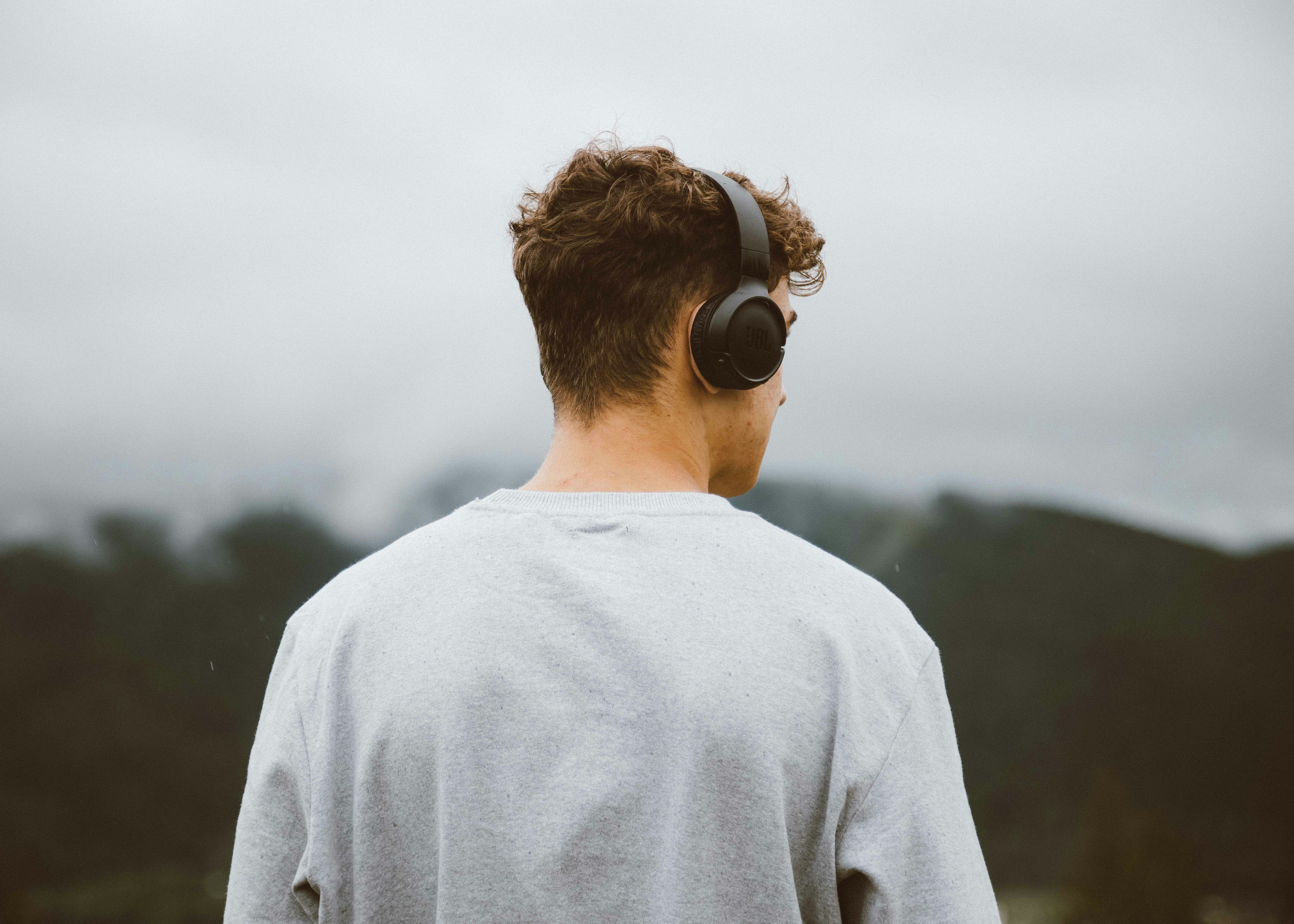
It is 8:20 on a Tuesday morning. The hallway smells of damp coats, floor polish, and burnt toast from the canteen. Fluorescent tubes hum at a pitch that vibrates in your jaw. Two dozen different conversations bounce off concrete walls, alongside the squeak of trainers and the clatter of locker doors. You reach into your pocket, pull out your earbuds, and slide them into your ears. You don't press play on anything. You just leave them there, dead silent, creating a thin rubber seal between your eardrums and the corridor.
A minute later, you tug your hood up over your head. The room isn't cold, but the fabric drops a pair of soft blinkers over your peripheral vision. When you walk into the classroom or the library, you take the chair tucked into the back corner, with your back against a solid wall and a clear sightline to the exit. None of these choices are accidental, and none of them are about antisocial posturing. They are small, instinctive adjustments to stop the world from crushing your bandwidth before the day has properly begun.
If you have ever felt self-conscious about these habits—or had an adult tell you to take your hood down, pull your earphones out, and look engaged—it is easy to internalise the idea that something is wrong with you. The assumption from the outside is often that you are checking out, being rude, or trying to look detached. In reality, the opposite is usually true: you are using physical buffers precisely so you can stay in the room without falling apart.
The physics of sensory load
Your brain does not simply absorb the world; it has to filter, sort, and categorise every single piece of data coming through your senses. It tracks the flickering light in the corner of your eye, the pitch of a voice three desks over, the scratch of a label against your neck, and the temperature of the air. Doing that processing takes actual physiological energy. When the volume of incoming data exceeds your brain's capacity to sort it, your nervous system interprets the environment as a low-level threat.
Every tool you reach for alters the physics of that incoming stream. Headphones reduce acoustic unpredictability, which is the most taxing kind of noise. A steady drone is easy for the brain to tune out, but sudden laughter, dropping books, or overlapping chatter force your attention to constantly reset. Placing physical barriers in your ears—even without music—dampens the sharp spikes of sound, giving your auditory cortex a chance to rest.
A hood or a low-slung baseball cap does the identical job for your visual field. By cutting out high overhead lighting and the constant, erratic movement of people around you, you reduce visual tracking by half. Sitting with your back to a wall does something similar for your nervous system: it eliminates the evolutionary need to monitor what is happening behind you. You secure your perimeter so your mind can focus entirely on what is in front of you.
Making the world quieter for yourself isn't hiding from it. It's how you stay able to actually be in it.
Staying in the room versus checking out
There is a vital distinction between self-regulation and avoidance, even though they can look identical from the outside. Self-regulation is the set of adjustments you make so that you can remain present, functional, and connected without tipping into overload. Avoidance is using those same adjustments to hide from experiences, connections, or challenges that you actually want or need to face.
Putting your headphones on during a chaotic bus ride so you arrive at school with enough mental energy to get through morning lessons is self-regulation. Keeping those headphones on when a friend sits down next to you and tries to catch your eye—because talking feels slightly uncomfortable—is avoidance. Neither makes you a bad person, but learning to tell the difference between them gives you agency over your choices.
The most honest diagnostic question you can ask yourself is simple: Is this habit helping me stay in the environment, or is it helping me pretend the environment doesn't exist? If a hoodie allows you to sit comfortably in a crowded common room and study, it is serving you. If pulling your hood down over your face is a way to escape asking for help when you are stuck, it is worth looking at what you are protecting yourself from.
The Spectrum of Sensory Accommodation
- Raw Exposure: No buffers, high cognitive strain, rapid exhaustion
- Reactive Defense: Sudden withdrawal after becoming overwhelmed
- Strategic Buffering: Using tools (headphones, seating) to manage load
- Sustainable Presence: Preserving energy to engage on your own terms
Building a proactive micro-toolkit
Most people only reach for their sensory tools when they are already at the red line—when the noise is already unbearable, their head is pounding, and their patience has snapped. At that stage, you are in crisis management. The real power of understanding your sensory profile comes from using your tools proactively, before the tank is empty.
This means thinking about your day in terms of sensory pacing. If you know third period is in a crowded, echoing science lab, you might make sure your commute to school is as low-stimulus as possible. You might choose to eat lunch in a quieter stairwell or outside for fifteen minutes rather than spending the entire break in the main hall. These small, deliberate choices accumulate, leaving you with reserves for the moments that matter.
Your toolkit does not need to look like anyone else's. For some people, it is tactile: a heavy ring they can twist, the texture of a denim jacket, or a smooth stone in their pocket that provides a grounding physical sensation when a room feels chaotic. For others, it is visual: sitting near natural window light instead of directly under buzzing strip lights, or downloading screen-dimming overlays for late-night study sessions.
Living with your own settings
We live in a culture that often equates resilience with total sensory numbness—the idea that a strong person should be able to sit under harsh lights, amidst relentless chatter, and perform perfectly without flinching. That is not resilience; it is simply biological variation being ignored. Having a nervous system that registers sound, light, and motion acutely is not a design flaw. It often comes paired with deep focus, high empathy, and a strong eye for detail.
You do not need to apologise for managing your inputs. You do not owe anyone an unbuffered version of yourself at every second of the day. When you know which tools keep you steady, you can navigate intense, crowded, demanding spaces on terms that work for you, keeping your energy intact for your own life.
Sources + further reading
- Sensory sensitivity and self-regulation strategies — American Psychological Association
General information, not medical advice. If something feels unmanageable, speak to a GP or a qualified professional.
Keep reading
For teens · Mind
When You're Overstimulated and Everyone Is Annoying You
It's not that people got worse today. It's that your nervous system has had enough.
For teens · Connection
Your Social Battery Is at One Percent
Wanting to be alone right now doesn't mean anything's wrong with your friendships. It means the tank's empty.

For teens · Connection
When Answering People Feels Like Work
You've read the message three times. You still haven't replied. That's not rudeness — it's something else.
Want to make this personal?