
For kids · Joy
Why Play Still Matters
It's not just fun and games. Play is how your brain does some of its best work.
Selfey Editorial · 7 min read
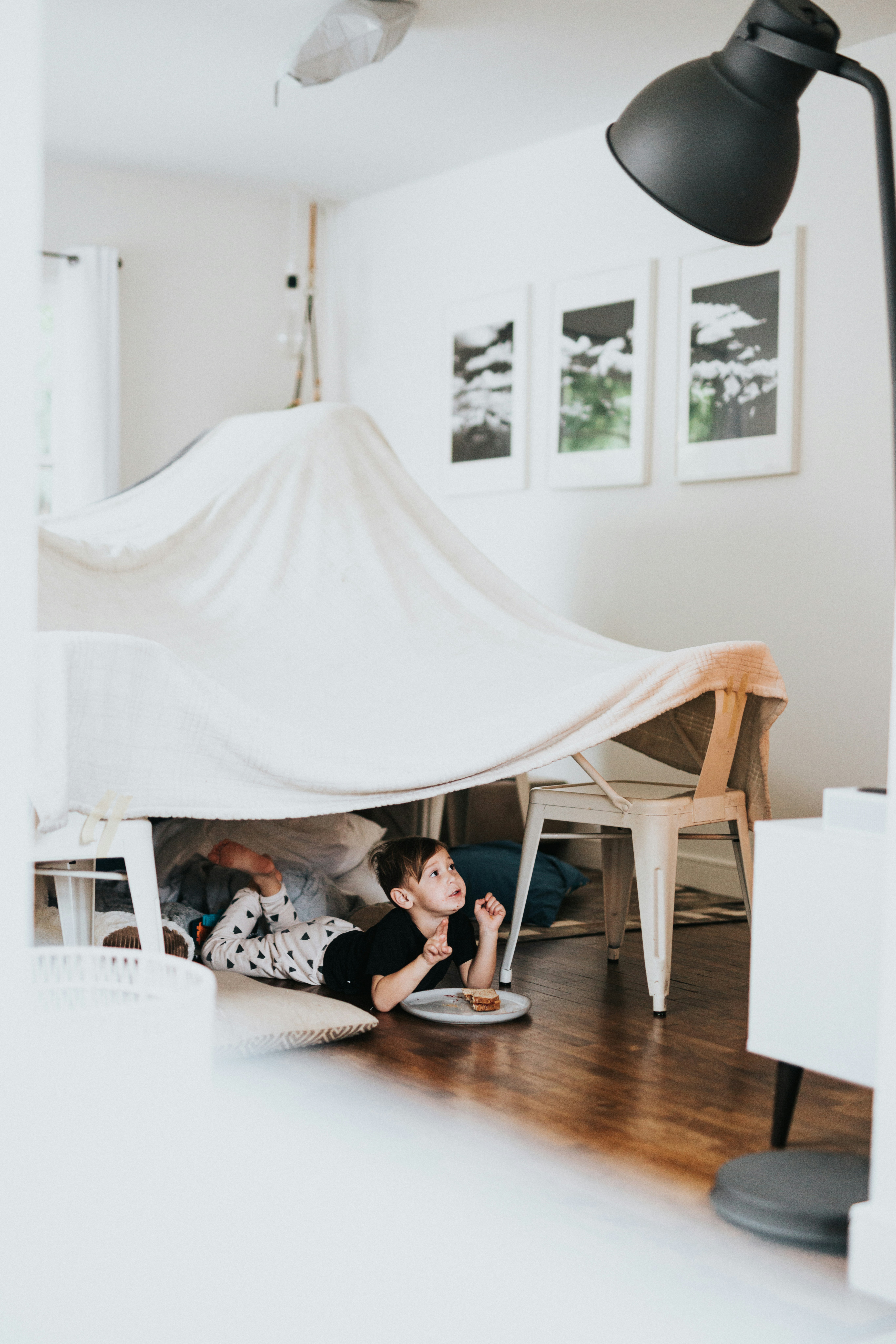
Three sofa cushions lean against the coffee table at an awkward angle, held in place by a heavy winter coat and two hardback books. On the rug, someone has lined up six plastic spoons, three dried penne tubes, and a cardboard tube from the kitchen roll. Nobody is speaking according to a script. A quiet negotiation is taking place over whether the floor is made of hot lava or deep swamp water, and the rules have already changed four times in six minutes.
From the kitchen doorway, this can look like mess, aimless wandering, or simply passing the time before something more structured begins. It is easy to view an afternoon like this as empty space waiting to be filled with something educational, organised, or productive. Yet beneath the apparent chaos of blankets, imaginary swamp water, and shifting rules, a child's nervous system is doing some of the most sophisticated developmental work it will ever do.
You do not need to convince a young person that play is enjoyable. What is far less obvious is that self-directed play is an evolutionary necessity. It is the primary vehicle through which growing brains wire themselves for emotional stability, social resilience, and complex problem-solving. Far from being a luxury or a reward saved for when real work is done, unstructured play is the foundational work of childhood.
The feeling of deep play
When play is working well, the sense of clock time tends to dissolve entirely. A child might set out to build a small fort under a dining chair, and suddenly an hour and a half has slipped past without a single request for a screen, a snack, or adult mediation. In psychological terms, this state is closely related to flow: an absorbed, immersive state of attention where the brain is fully engaged in an intrinsic task.
During deep play, progress is rarely linear. A child might spend twenty minutes building a tower only to knock it down intentionally, or invent a game with twenty meticulous rules only to abandon them when an entirely new premise emerges. To an adult eye trained on productivity, this can look like wasted effort or giving up halfway through. In reality, the goal of free play is never the finished product. The goal is the continuous, live problem-solving that happens while making and remaking the rules.
Disagreements during these moments are not failures of the game; they are the heart of it. When two children argue over who gets to hold the cardboard sword or whether a toy animal can fly, they are learning how to negotiate boundaries, tolerate frustration, and keep a shared social reality intact. If they push too hard, the game falls apart and everyone walks away; if they compromise, the play continues. That immediate feedback teaches emotional calibration in a way no lecture can replicate.
How the brain practises in secret
When a child decides to pretend a stick is a magic staff or an old blanket is an impenetrable bunker, their brain is quietly rehearsing executive functions. Executive function is the suite of mental processes that includes working memory, cognitive flexibility, and inhibitory control. These are the internal tools that allow human beings to plan ahead, juggle multiple ideas at once, adapt to changing circumstances, and resist impulsive reactions.
In adult-led settings, such as classrooms, sports clubs, or guided workshops, these executive decisions are largely managed by someone else. The coach decides when the drill ends, the teacher decides what materials to use, and the adult steps in to resolve disputes before they boil over. While structured activities offer valuable technical skills, they remove the burden of decision-making from the child.
Free play restores that burden in a safe, low-stakes environment. In an imaginary world of their own making, a child is entirely in charge of setting constraints, managing risk, and dealing with mistakes. If a tower collapses, there is no grade attached and no adult disappointment to manage; there is only physical gravity and the immediate choice to try building a wider base. This builds self-efficacy, which is the internal conviction that one can influence one's own circumstances.
The Spectrum of Agency in Childhood Activities
- Structured lessons with strict rules and predefined outcomes
- Guided activities where adults provide the framework and steps
- Semi-structured play with thematic boundaries or adult prompts
- Open-ended games with collaborative, negotiated rules
- Pure self-directed free play with total autonomy over materials and goals
What genuine play looks like
Modern consumer culture often frames play as something that requires specialized equipment: plastic playsets tied to commercial films, intricate craft kits with single intended outcomes, or digital games with algorithmic reward loops. But the richness of play is almost never determined by the complexity of the toy. In fact, high-tech toys often do the imaginative work for the child, leaving very little room for cognitive exploration.
The most fertile ground for play is made of low-structure materials that can become anything. Cardboard boxes, scrap fabric, masking tape, fallen branches, loose cushions, and open floor space invite open-ended experimentation. When an object does not have an obvious intended purpose, the brain must supply one through imagination.
- Inventing a game with completely arbitrary, self-made rules
- Pottering around outdoors with no specific destination or collection goal
- Building a structure using whatever household objects are available, without an instruction manual
- Adopting an imaginary persona and testing out different social roles or emotional states
- Arguing over a rule, pausing the game, rewriting the rule, and carrying on
Play is not the reward an exhausted mind earns after finishing the real work. Play is the primary engine of development.
The caregiver's hardest task: stepping back
For parents and caregivers, the modern environment creates tremendous pressure to optimize every hour of a child's life. The cultural message is pervasive: if an afternoon is not filled with structured enrichment, athletic development, or educational advancement, that time is somehow being squandered. This understandable anxiety drives schedules to the brink of exhaustion.
Protecting play requires an intentional willingness to step back and tolerate what looks like unproductivity. It means allowing children to experience the brief, uncomfortable boundary of boredom without immediately handing them a device or prescribing an activity. Boredom is often the doorway through which true internal motivation emerges; it is the friction that forces a child to look around the room and ask what they might make happen next.
When supporting play, the adult's primary contribution is often environmental rather than instructional. It consists of providing physical safety, granting uninterrupted time, offering raw materials, and then removing oneself from the director's chair. Light supervision from the edge of the room—being available if emotional or physical safety requires it, but otherwise staying out of the narrative—communicates trust in the child's capability.
Protecting space on the calendar
Because unscheduled time is easily swallowed by homework, extracurricular commitments, and domestic logistics, free play must be treated with the same institutional respect as a dentist appointment or a music lesson. If it is not deliberately ring-fenced, the default pace of modern family life will inevitably crowd it out.
Treating open time as sacred does not require restructuring your entire life overnight. It begins with noticing the empty spaces on the weekend and resisting the reflex to fill them with errands or organized outings. A quiet afternoon at home with nothing particular to achieve is often the most generous developmental gift a caregiver can offer.
From the research
Sources + further reading
- The Decline of Play and the Rise of Psychopathology — American Journal of Play (Peter Gray)
- The Power of Play — American Academy of Pediatrics
General information, not medical advice. If something feels unmanageable, speak to a GP or a qualified professional.
Keep reading
For adults · Joy
What Do You Even Do for Fun Any More?
Someone asks, at a dinner or a check-up or a first date, and there's an actual pause before you answer. That pause is worth taking seriously.

For kids · Life
When Your Day Has Too Many Things In It
School, then a club, then homework, then another thing — no wonder it feels like a lot.

For parents & caregivers · Rest
Why Boredom Can Be Good for Kids
The urge to fill every gap in the day is understandable — but empty time is doing more for your child than it looks like.
Want to make this personal?