
For parents & caregivers · Rest
Why Boredom Can Be Good for Kids
The urge to fill every gap in the day is understandable — but empty time is doing more for your child than it looks like.
Selfey Editorial · 7 min read

It is four o'clock on a damp Sunday afternoon, and your seven-year-old is draped across the living room sofa, staring at the ceiling and emitting a slow, theatrical sigh. Then comes the familiar complaint, delivered with real grievance: "I am bored." Your instinct, honed by years of managing schedules and tending to needs, fires instantly. You begin listing options before you have even dried your hands on the tea towel. You could draw, you could build a fort with the cushions, what about that jigsaw from your birthday, would you like to help me chop vegetables for dinner? Every suggestion is rejected with an irritable shake of the head.
It is an intensely uncomfortable moment for most caregivers. In a modern culture that quietly equates responsible parenting with constant enrichment, structured classes, and curated stimulation, a child with nothing to do can feel like an administrative failure. We hear a child say they are bored and translate it internally as an emergency to solve, or worse, a quiet accusation that we have not provided enough.
Yet that flat, restless stretch of empty time is rarely a problem to be fixed. Left alone for twenty minutes, without adult intervention or an immediate glowing screen to fill the gap, boredom is usually doing something quietly restorative. It is the necessary, fertile pause that allows a child's nervous system to decelerate and gives them the room to discover who they are when no one is handing them an agenda.
The uncomfortable middle stretch
The transition from structured activity to self-directed play is rarely smooth or peaceful. There is almost always a turbulent middle phase that looks, to a watching parent, remarkably unproductive. A child who has run out of prescribed activities might pace the hallway, complain loudly, rearrange their bedside table for no apparent reason, or lie on the carpet picking at the rug.
This restless interval is not evidence that boredom has failed; it is simply the sensation of a child's brain adjusting down from high stimulation. In an environment rich in rapid transitions, school bells, and high-contrast digital media, an empty afternoon feels physically jarring. It takes several minutes for that internal static to clear and for their attention to settle back into their immediate physical surroundings.
If an adult steps in during those initial ten minutes with an entertainment plan, the child is spared the discomfort, but they also miss out on the breakthrough that lies on the other side. They learn that stillness is an unbearable state that requires external rescue, rather than an internal cue to look around and invent something of their own.
Boredom is not empty time gone wrong. It is often just the doorway a child has to walk through before they find their own idea.
Why empty space builds agency
When every hour of a child's week is planned and supervised—swimming on Tuesday, football on Thursday, curated educational apps on the weekend—the child becomes proficient at compliance, but gets very little practice with autonomy. They become passive consumers of experience rather than active authors of it. Deciding what to do with sixty minutes of completely unstructured time requires an entirely different set of psychological muscles: tolerance of uncertainty, self-reflection, and creative initiative.
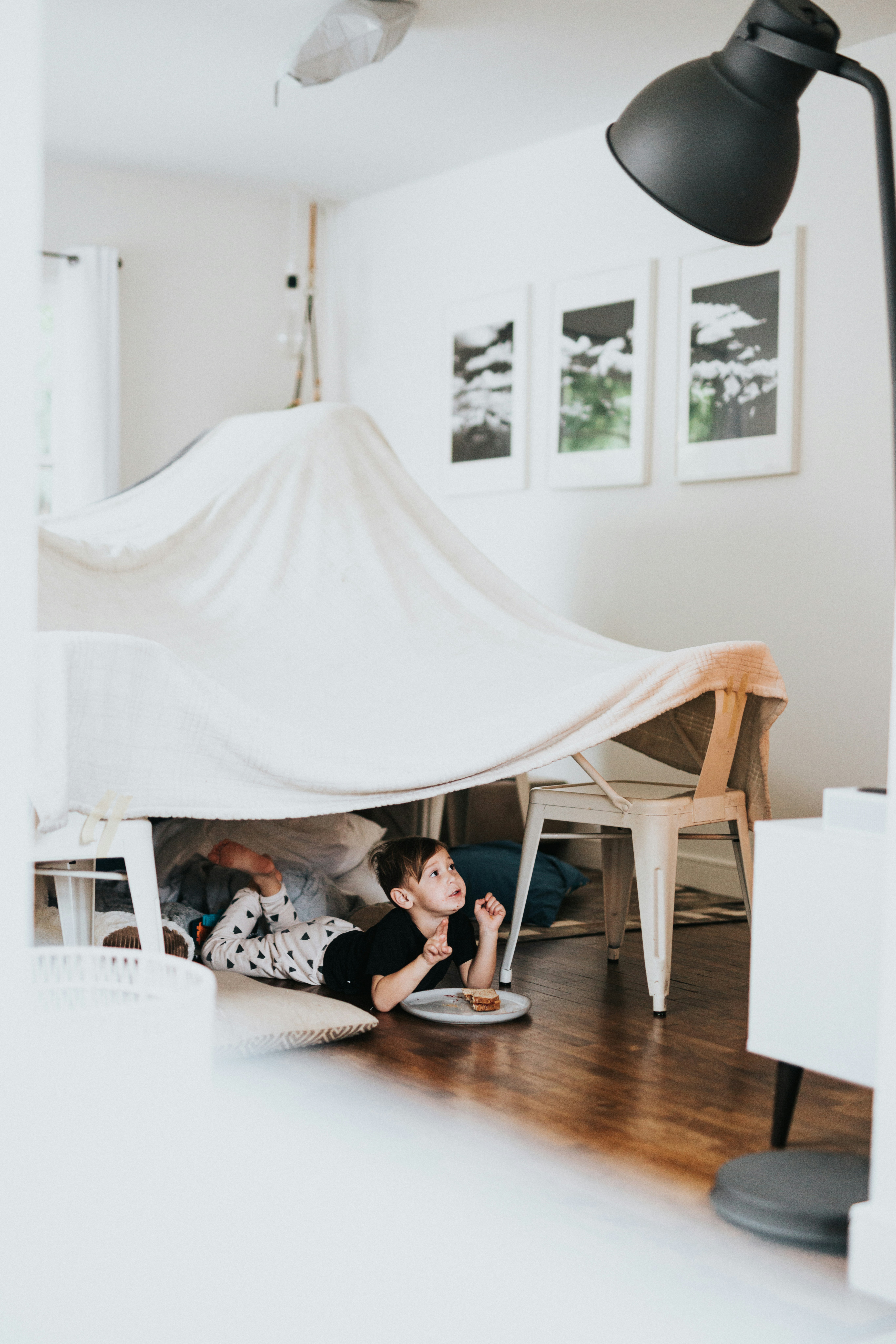
In the absence of an adult's instruction, children naturally turn toward self-directed play. They experiment with the physical environment, transform everyday cardboard boxes into elaborate vehicles, or simply gaze out of the window and daydream. This open-ended mind wandering is precisely where emotional processing happens, giving children space to digest the social dynamics of school, the frustrations of the week, or the quiet anxieties they have not yet found words for.
When children manage their own playtime, they must also manage their own small frustrations. An elaborate cushion tower falls over, an imaginary rule needs amending, or an experiment with water and paper fails. Navigating these minor, low-stakes obstacles without an adult stepping in to referee or correct them is how self-regulation is built from the inside out.
The natural arc of unstructured time
Empty space: structured demands end
The restless gap: discomfort and complaining
De-escalation: sensory settling and scanning the room
Internal ignition: an idea forms from boredom
Deep absorption: self-directed, open-ended play
The friction of modern interruptions
Screens have fundamentally altered the landscape of childhood boredom. A digital device is a frictionless remedy for an empty afternoon; it removes the uncomfortable restlessness instantly, providing constant, highly engaging content without requiring any imaginative effort from the child.
This does not mean screens must be banned entirely, or that a parent should feel guilty for putting on an audiobook or a film during an exhausting afternoon. However, when screens become the default, immediate answer to every lull, a child never develops the stamina required to tolerate being under-stimulated. Over time, their threshold for boredom drops, making ordinary life feel even flatter and harder to bear.
Keeping digital media for designated, predictable times rather than using it as an emergency pacifier protects that generative gap. When a child realises that a screen is simply not an option for this particular hour, their attention stops waiting for digital stimulation and turns outward toward the physical room.
Holding space without abandoning them
Giving children room to be bored does not mean ignoring them or treating their frustration with cold indifference. Often, when a child complains of having nothing to do, they are not just looking for a toy; they are seeking a brief moment of connection before they feel settled enough to play independently. Their emotional battery needs a quick top-up before they can venture off on their own.
A small touchpoint can make all the difference. Sitting with them on the rug for five minutes, offering a gentle shoulder squeeze, or acknowledging their feeling without fixing it—"It really is hard when you don't know what to do next"—validates their experience without taking over the job of entertaining them. You are offering connection, not an itinerary.
How boredom manifests also changes with age. A younger child may need open-ended materials placed within reach—baskets of scrap cardboard, wooden pegs, fabric scraps, or plastic tubs—to spark their curiosity. An older child or teenager may simply need explicit permission to rest, lie on their bed, and listen to the rain without being told they are wasting their time or being lazy.
It is equally worthwhile to communicate this stance to other caregivers, grandparents, or babysitters. Well-meaning adults often feel a strong obligation to keep visiting children constantly occupied. A brief word in advance—mentioning that you are deliberately giving the children unscheduled time to figure out their own games—can prevent someone from stepping in prematurely and interrupting an idea while it is still forming.
- Wait ten to fifteen minutes before offering any activity suggestions when a child complains of boredom.
- Keep loose, open-ended materials accessible, such as paper, cardboard boxes, tape, and blankets, rather than exclusively single-purpose toys.
- Protect a weekly block of completely unscheduled time in the family calendar, treating it with the same importance as a sport or music lesson.
- Reframe the conversation calmly when boredom arises, using phrases like 'Your brain has some quiet space right now' instead of treating it as a problem.
- Observe the strange, creative games that eventually emerge from the empty time without directing or correcting the play.
From the research
Play Isn't Just Fun — It Helps Growing Brains Recover
Free, child-led play appears to build real skills — problem-solving, creativity, handling feelings — and children generally have less of it than they used to.
American Journal of Play — 'The Decline of Play and the Rise of Psychopathology in Children and Adolescents' · 2011Kids' Brains Need Proper Downtime, Not Just Sleep
Children generally need both enough hours of sleep and some real unstructured downtime during the day to feel steady.
Recommended Amount of Sleep for Pediatric Populations · 2016
Sources + further reading
- Decline of Play and Rise in Children's Mental Disorders — Peter Gray, American Journal of Play
- The Power of Play — American Academy of Pediatrics
General information, not medical advice. If something feels unmanageable, speak to a GP or a qualified professional.
Keep reading
For kids · Joy
Why Play Still Matters
It's not just fun and games. Play is how your brain does some of its best work.

For kids · Life
When Your Day Has Too Many Things In It
School, then a club, then homework, then another thing — no wonder it feels like a lot.

For parents & caregivers · Body
Getting Kids Moving Without Turning It Into a Programme
You don't need a class, a schedule or the right equipment. You need permission to let it be messy, unstructured, and short.
Want to make this personal?